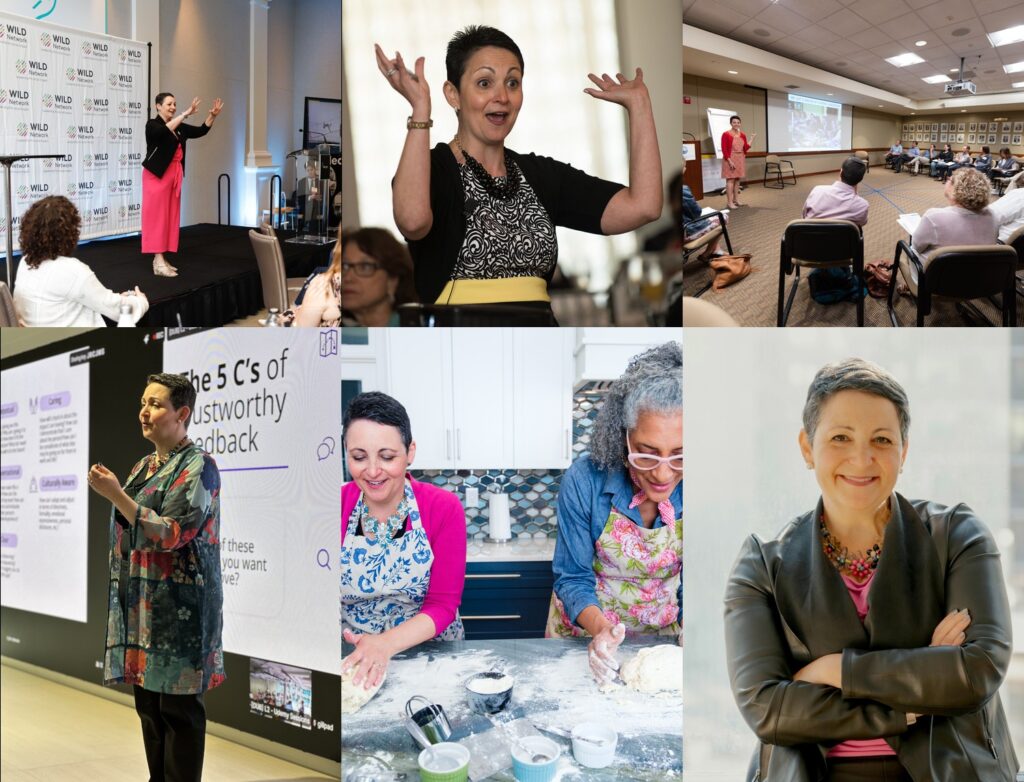
About Deborah

Short bio
Deborah Grayson Riegel is a keynote speaker, executive coach, and consultant who has taught leadership communication for Wharton Business School, Duke’s Fuqua Business School, Columbia Business School’s Women in Leadership Program, and the Beijing International MBA Program at Peking University. She writes on leadership communication and presentation skills for Harvard Business Review, Inc., Psychology Today, Forbes, and Fast Company, and has been featured in Bloomberg Businessweek, The Wall Street Journal, and The New York Times. Deborah’s clients range from Amazon, Blackrock, and Google to J&J, NASA, and The United States Army. She is the author of “Aim High and Bounce Back: A Successful Woman’s Guide to Rethinking and Rising Up from Failure”, “Go to Help: 31 Strategies to Offer, Ask for, and Accept Help” and “Overcoming Overthinking: 36 Ways to Tame Anxiety for Work, School, and Life”.
Long bio
Deborah Grayson Riegel is a leadership communication expert, executive coach, keynote speaker, educator, and author who helps leaders and teams communicate with greater confidence, clarity, and impact.
A competitive public speaker in high school (yes, that’s a real thing), Deborah never imagined that her extracurricular activity would become the foundation of a decades-long career. Today, she teaches, coaches, and speaks around the world, partnering with Fortune 500 companies, entrepreneurial startups, mission-driven nonprofits, government agencies, and leading academic institutions to help professionals strengthen their communication, leadership, and interpersonal effectiveness.
Deborah has served as an Instructor of Management Communication at The Wharton School of the University of Pennsylvania and partners with leading business schools and executive education programs, including Columbia Business School and Duke University, to deliver custom leadership development experiences for executives and emerging leaders.
Throughout her career, she has worked with professionals across industries and around the globe, helping them navigate difficult conversations, lead through uncertainty, communicate change, and build stronger workplace relationships.
A sought-after thought leader on leadership, communication, resilience, and emotional intelligence, Deborah is a regular contributor to Harvard Business Review and Psychology Today. Her insights have also appeared in The New York Times, Forbes, Fast Company, Bloomberg Businessweek, Oprah Magazine, Fox Business Network, and other prominent media outlets.
Deborah is the author of multiple books, including her newest release, Aim High and Bounce Back: A Successful Woman’s Guide to Rethinking and Rising Up from Failure; Overcoming Overthinking: 36 Ways to Tame Anxiety for Work, School, and Life; Oy Vey! Isn’t a Strategy: 25 Solutions for Personal and Professional Success; Money Talks: 100 Strategies to Master Tricky Conversations About Money; and Tips of the Tongue: The Nonnative English Speaker’s Guide to Mastering Public Speaking. She is also a contributing author to several Harvard Business Review books, including Emotional Intelligence, Mental Health, and Women at Work.
Drawing on her background in psychology, executive coaching, appreciative inquiry, communication, and improvisational comedy, Deborah brings a unique blend of research, practicality, and humor to her work. Her approach helps individuals and teams think more clearly, communicate more effectively, and respond more skillfully to challenges, change, and complexity.
Deborah holds a B.A. in Psychology from the University of Michigan and an M.S.W. from Columbia University. She is a graduate of Coach U and the Coaches Training Institute and holds the Professional Certified Coach (PCC) credential from the International Coaching Federation.
Whether she is coaching a senior executive, facilitating a leadership program, or delivering a keynote presentation, Deborah’s mission is to help people become more effective communicators, more resilient leaders, and more authentic versions of themselves.